Concord Middle School
Concord, MA
Category: 2026 Education, Unique Installation Challenge
Gold Winner Unique Installation,
Gold Winner Rob Starr People's Choice Award,
Silver Winner Education
Architect: Ewing Cole
Designer: SMMA
Starnet Member:
Capital Carpet & Flooring Specialists, Inc.
Starnet Preferred Vendors:
Ardex, CLIMIT, Mapei, Taylor Adhesives, ECOSurfaces, Roppe, Tarkett, C/F Data Systems, LLC
Project Strategy
The new Concord Middle School Design realizes the goal of Concord Public Schools to replace two existing facilities with one combined middle school housing grades six through eight. The facility is designed to serve students and the community for generations. The school will accommodate a 700-student population projected enrollment. The project incorporates a team-teaching model and appropriate space to support positive learning environments to meet the educational needs of Middle School students. The project will be designed to achieve net-zero energy operations.
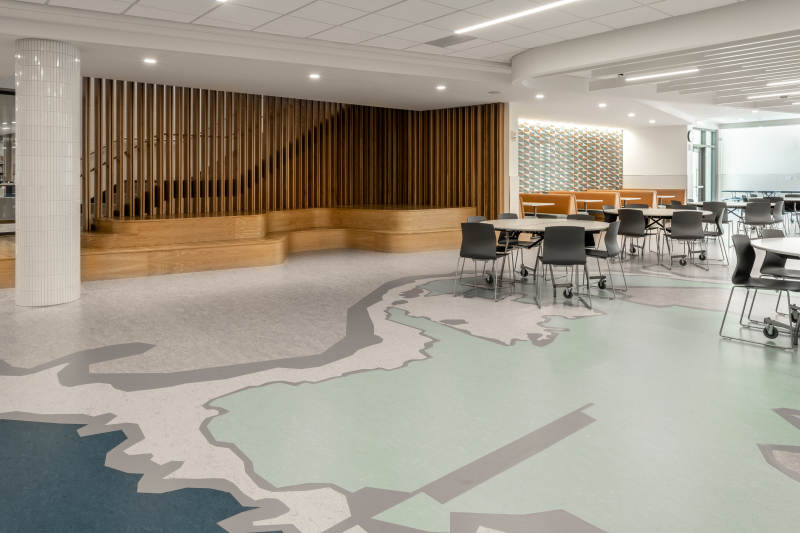
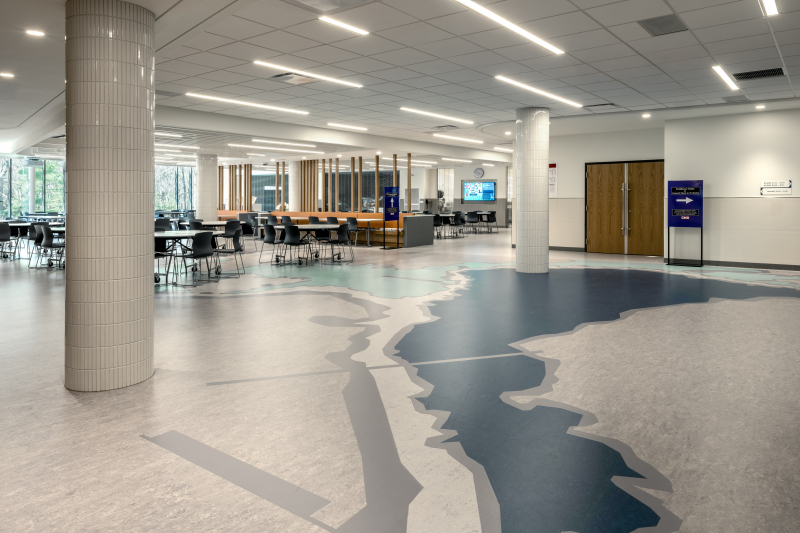
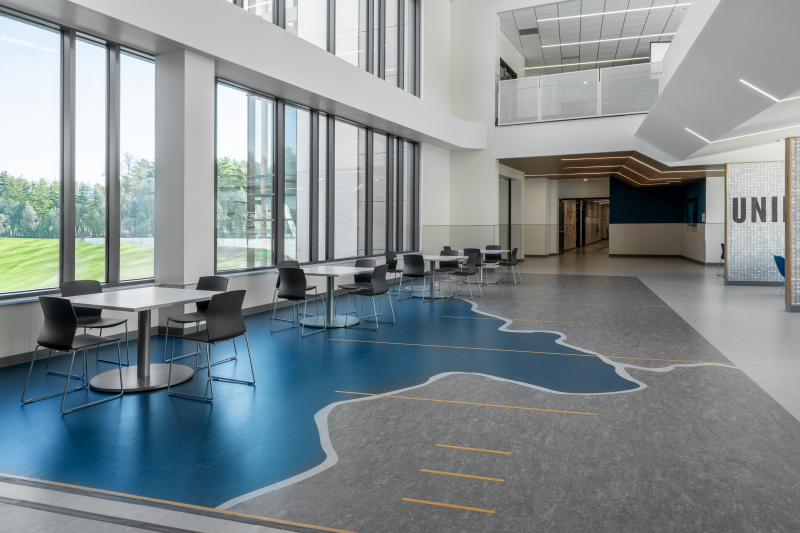
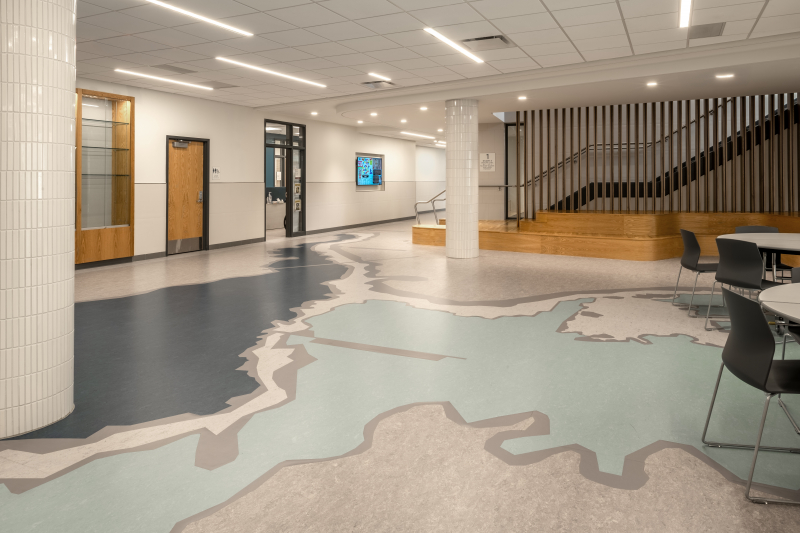
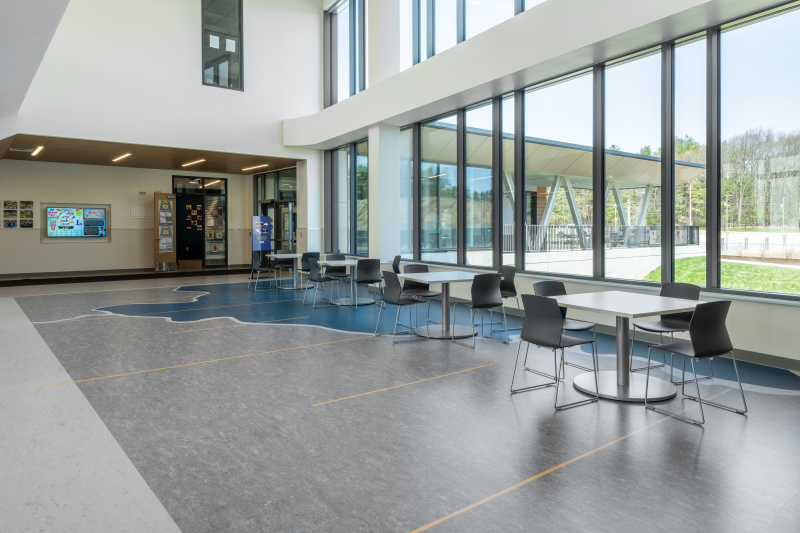
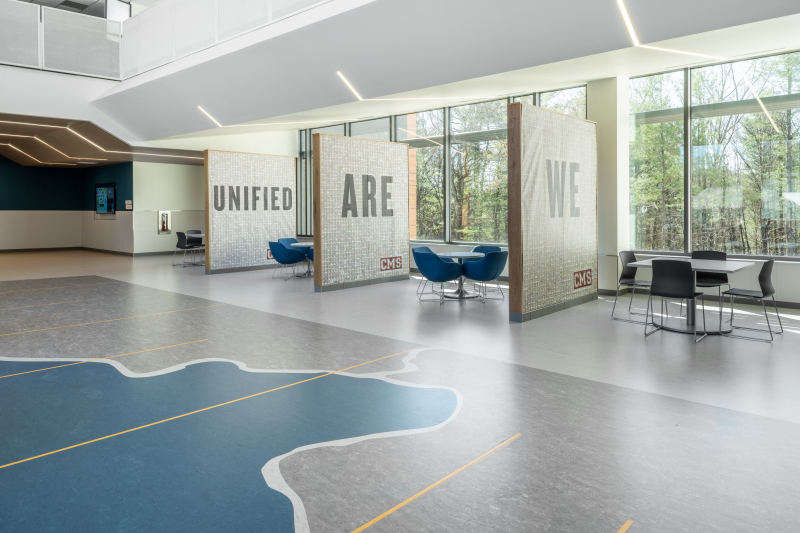
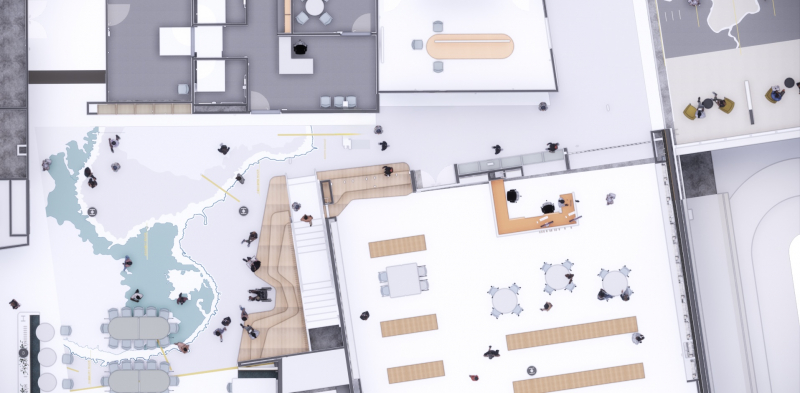
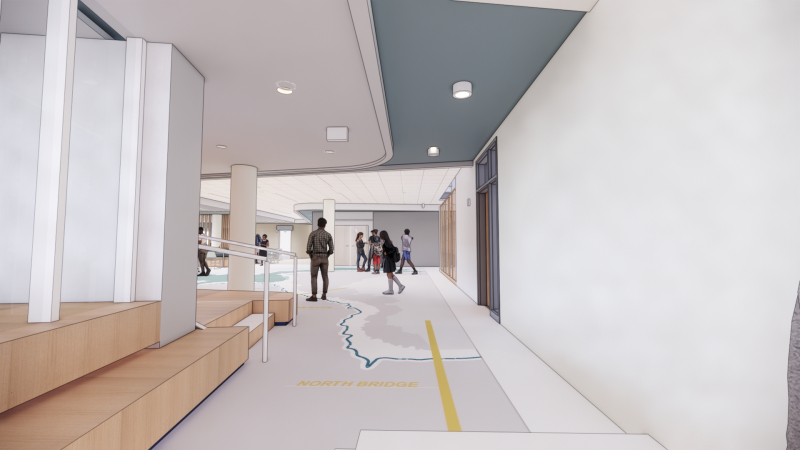
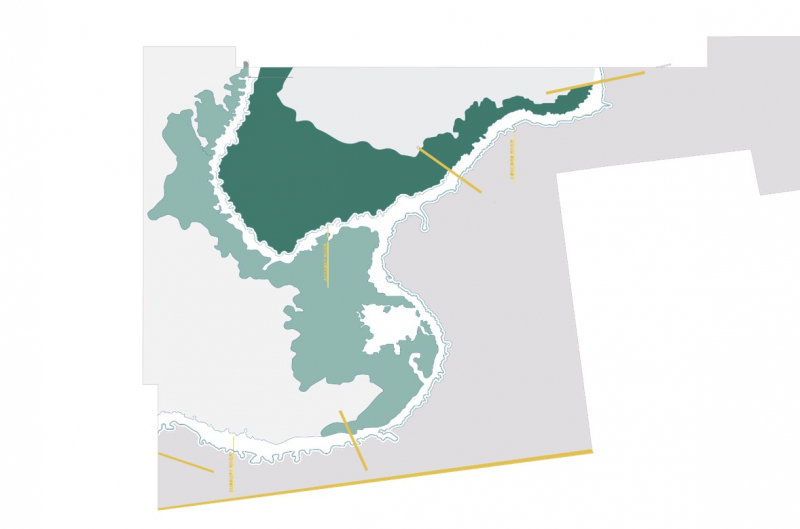
The Dining Commons, at the confluence of the school, where the media center, auditorium, and cafeteria meet, the space is anchored by a learning stair shaped by the river’s contours. It offers students a place to gather that is both sheltered and connected. The floor graphic illustrates the region’s converging rivers, with color blocking symbolizing the shoreline. Bridges across the waterways emphasize the theme of connection – just as the bridge lobby links teams to shared spaces, allowing nature to flow beneath the building. The Old North Bridge aligns with the corridor leading to the media center and the angle of the building.
The graphic of the bridge illustrates the Concord River’s journey from the north, with markers at mile intervals spaced every six feet. It helps students grasp the river’s scale, emphasizing its connection to the broader landscape while reinforcing the themes of movement and flow. The graphic also serves as a measuring tool, ideal for experiments. A subtle nod to the project’s inspiration, the “dot” marks the location of Thoreau’s farm. This point should offer a perfect view down the ravine and encourage a connection to nature.
Unique Installation Challenge Strategy
During the initial stages of installation, we encountered unforeseen challenges due to preexisting conditions on-site. Specifically, the adhesive originally specified was incompatible with the existing concrete surface, preventing the flooring material from properly bonding.
After extensive troubleshooting and multiple trials with alternative solutions, we identified Taylor Enhanced Surface Bond as the most effective product. It provided the necessary adhesion strength and compatibility with the substrate, allowing us to proceed with the installation confidently and meet the required performance standards.
The intricate flooring patterns were designed to express the region’s rivers and historic bridge crossings as part of a larger place-based narrative. These complex designs and intricate patterns present a significant challenge, as it demands exacting precision to preserve design continuity and professional quality.